
Beyond Outsourcing: How AI Automation Is Redefining Managed Services and Enterprise Operations
The defining question for the next generation of managed services is no longer who can manage an organization's technology at the lowest cost; but who can intelligently operate, continuously improve and securely govern that technology while delivering measurable enterprise value.
 Ogochukwu Paragon Etu, Ph.D7 min read
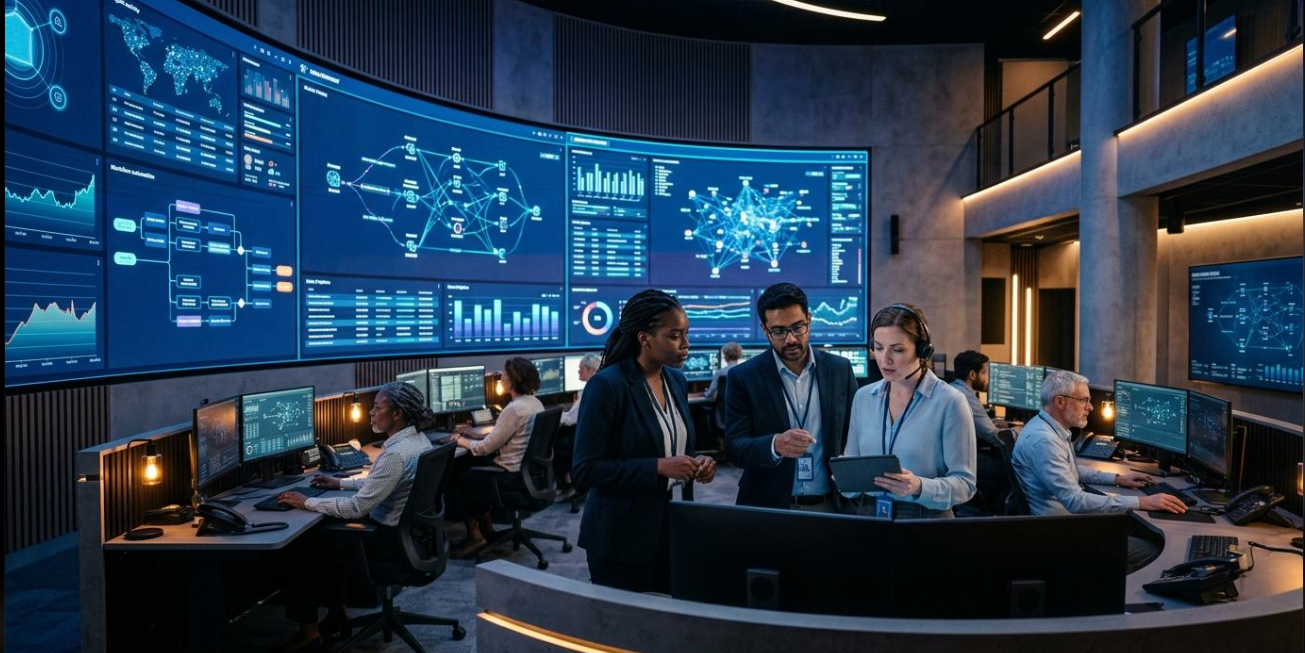
The managed services industry is undergoing a fundamental transformation. For decades, organizations have relied on external technology providers to manage IT infrastructure, enterprise applications, cybersecurity, cloud environments and business operations. The traditional value proposition centred on cost reduction, operational efficiency, access to expertise and service reliability. However, artificial intelligence (AI), intelligent automation and agentic AI are redefining this model.
Managed services are moving beyond the conventional outsourcing of people and processes towards intelligent operating environments where AI can monitor systems, identify anomalies, analyse operational data, automate workflows and support faster decision-making. This evolution raises an important question: are organizations still outsourcing operational activities, or are they investing in intelligent capabilities that continuously improve enterprise performance?
The distinction is significant. Traditional managed services models often relied on human resources, service tickets, predefined procedures and service-level agreements. While these remain relevant, AI is changing how services are delivered and measured. The competitive advantage is gradually shifting from the number of resources deployed to the ability to combine human expertise, automation, intelligent platforms and domain knowledge to deliver measurable business outcomes.
Leading technology service providers are already positioning themselves for this transition. Tata Consultancy Services (TCS), through its AI-led transformation initiatives and platforms such as ignio, is advancing intelligent automation across infrastructure management, application operations, cloud services and business processes. Its Human + AI approach reflects the industry's movement towards more autonomous and outcome-driven service delivery. Similarly, Infosys, through Infosys Topaz, is integrating generative AI, enterprise data and automation into business transformation and managed services. Its collaboration with Amazon Web Services (AWS), including the integration of Infosys Topaz with Amazon Q Developer, illustrates how enterprise AI is becoming increasingly embedded in software engineering and operational workflows.
AWS occupies a particularly important position as the cloud infrastructure and AI foundation supporting this transformation. Through services such as Amazon Bedrock and Amazon Q, organizations can develop generative AI applications, automate enterprise workflows and build intelligent cloud environments. Its ecosystem of consulting and managed services partners enables enterprises to combine cloud capabilities with implementation expertise, industry knowledge and ongoing operational support. Together, TCS, Infosys, AWS and other technology providers demonstrate how the managed services ecosystem is evolving towards integrated, intelligent and increasingly automated operations.
However, the real challenge is not simply introducing AI into existing environments. It is ensuring that automation operates reliably within complex enterprise architectures. Many organizations depend on interconnected systems such as SAP, Oracle, Microsoft enterprise applications, customer relationship management platforms, data warehouses and identity management solutions. These systems contain years of business logic, operational information, access policies and institutional knowledge. Introducing AI without understanding these dependencies can create additional complexity rather than business value. Intelligent automation must therefore be supported by trusted data, effective integration, identity governance, cybersecurity controls and clear operational accountability.
Cybersecurity becomes even more critical as AI agents gain the ability to access enterprise applications, retrieve information and execute tasks. Organizations must establish clear boundaries around what these agents can access, which actions they can perform and how their activities are monitored. Data protection, least-privilege access, auditability, human oversight and AI governance must become integral components of managed services architecture. Automation should improve operational efficiency without weakening enterprise control.
The commercial implications are equally important. Traditional managed services contracts have often been structured around personnel, service hours, infrastructure capacity and predefined service-level commitments. However, as AI reduces the manual effort required for certain activities, enterprises will increasingly question whether resource-based pricing accurately reflects the value being delivered. If automation improves incident resolution, reduces repetitive service requests and strengthens infrastructure availability, commercial models must evolve towards measurable outcomes, productivity improvements and continuous service optimization.
This creates a new responsibility for technology procurement and strategic sourcing professionals. Provider selection must extend beyond labour rates, technical certifications and brand reputation. Organizations should evaluate AI maturity, automation capabilities, integration expertise, cybersecurity controls, data governance, intellectual property arrangements, service continuity and the ability to demonstrate measurable business value. Contracts must also address accountability for AI-driven actions, data usage, audit rights, incident escalation and exit arrangements. The objective should not simply be vendor consolidation, but the development of a balanced supplier ecosystem that supports commercial efficiency, operational resilience and strategic flexibility.
The future workforce will also change. As repetitive operational activities become increasingly automated, demand will grow for professionals with expertise in AI engineering, cloud architecture, cybersecurity, data governance, automation design and technology risk management. Human specialists will increasingly focus on supervising intelligent systems, resolving complex exceptions, managing risk and improving automated processes. Outsourcing operational execution, however, does not transfer an organization's ultimate responsibility for its data, systems, regulatory obligations or business continuity.
Ultimately, the future of managed services will not be determined by how many activities organizations can outsource or how many AI tools providers can deploy. It will depend on how effectively technology, automation, human expertise, enterprise architecture and governance combine to create reliable and measurable business outcomes.
For enterprises, the opportunity is to move beyond outsourcing as a cost-reduction strategy and embrace managed services as an instrument of digital transformation, operational resilience and sustainable competitiveness. For procurement leaders, this means negotiating for measurable outcomes rather than simply purchasing resources. For technology executives, it means building secure and intelligent operating environments that can continuously adapt to changing business requirements.

Written by
Ogochukwu Paragon Etu, Ph.D
Editor
Technology Procurement Specialist | Digital Transformation | AI & Data Analytics | Information Systems Engineering | 5G Bandwidth Optimization.